Quarters Optional: How Asian Arcade Hardware Is Turning US Living Rooms Into the Hangout Spot Everyone Actually Wants to Visit
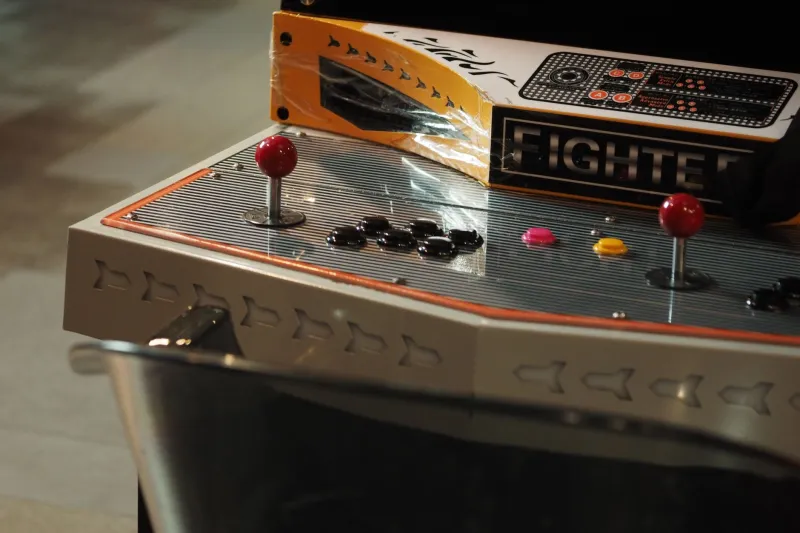
Darryl Kim's basement in suburban Chicago doesn't look like a living room anymore. It looks like someone teleported a corner of Akihabara directly into the Midwest. There's a full-size Taito Egret II Mini set up next to a custom Korean fight stick station. A row of NEOGEO cartridges sits under glass. His friends come over every Friday. Nobody checks their phones much. Nobody wants to leave.
"I've had people who don't even like video games come over and not want to go home," Darryl says. "There's something about the physical stuff — the buttons, the joystick, the screen — that a couch and a controller just doesn't replicate."
Darryl isn't alone. Across the US, a growing number of gamers are going deep on Asian arcade hardware — Japanese candy cabinets, Korean-manufactured fight sticks, imported retro consoles — and turning their homes into social destinations that function less like gaming setups and more like third places. Not quite home, not quite a bar. Something in between.
What's a "Third Place" and Why Does It Matter Right Now
Urban sociologists use the term "third place" to describe the spaces that aren't home and aren't work — the coffee shop, the barbershop, the local bar — where community actually forms. The US has been losing third places for decades. Malls closed. Arcades shut down. Pandemic accelerated everything.
For a lot of Gen Z and millennial gamers, the digital world was supposed to fill that gap. And it sort of did, until it didn't. Online lobbies are anonymous, often toxic, and fundamentally lonely in a way that's hard to articulate but easy to feel. You can play with a hundred people and still feel completely isolated.
The Asian arcade-at-home movement offers something different: a physical space, shared hardware, and the kind of shoulder-to-shoulder competition that only exists when you're actually in the same room as another human being.
The Hardware That's Fueling It
Japanese arcade manufacturers have been quietly making home-scale versions of their legendary hardware for years. The Taito Egret II Mini, the Astro City Mini, the SNK NEOGEO Arcade Stick Pro — these aren't knockoffs or emulation boxes dressed up in retro clothing. They're precision-built machines from the same companies that stocked arcades across Asia for thirty years, now sized for living rooms and priced (relatively) for serious enthusiasts.
Fight sticks are a separate category entirely. Korean manufacturers like Samducksa — makers of the legendary Crown CWL-309MJ joystick — have built a cult following among US fighting game players who swear the Korean lever mechanism is mechanically superior to Japanese ball-top sticks for certain playstyles. Entire subreddits are dedicated to the debate. Collectors obsess over it the way audiophiles obsess over turntable needles.
Then there's the import market. Sites that specialize in bringing Japanese and Korean arcade hardware to US buyers have seen order volumes climb steadily since 2021. Shipping costs are real — a full-size Japanese candy cabinet can run anywhere from $800 to $3,000 landed in the US — but demand hasn't softened.
"I thought it would be a niche thing," says one importer who asked to remain anonymous because he operates across a gray area of commercial import regulations. "But every month it gets bigger. People aren't just buying for themselves. They're buying to host."
The Economics of Going Arcade at Home
Building a real Asian arcade setup isn't cheap, but it's also not as prohibitive as it used to be. The secondary market for Japanese arcade hardware has matured significantly in the US, with Facebook groups, Discord servers, and dedicated forums facilitating sales between collectors. A starter fight stick from a reputable Korean or Japanese manufacturer runs $150–$300. A mid-range candy cabinet setup with a solid game library can be assembled for under $2,000 if you're patient and willing to hunt.
For context, a decent home theater setup costs more. A bar tab for a group of eight on a Friday night in any major US city costs more. Framed that way, the arcade cabinet starts looking less like an extravagance and more like an investment in a social infrastructure that actually pays dividends.
And it does pay dividends. Ask anyone who's hosted a regular fight night. The regulars show up. They bring food. They stay late. They come back.
Why This Hits Different for Gen Z
There's a generational dimension to this that's worth sitting with. Gen Z grew up with the most sophisticated digital entertainment ever created and is, by most measures, the loneliest generation on record. The connection between those two facts isn't coincidental.
What Asian arcade culture offers — and what its US living room adaptation preserves — is friction. Good friction. The kind that makes you actually engage with the people around you. Watching someone play a fighting game in person, coaching them through a combo, trash-talking a friend across a stick — these interactions require presence in a way that voice chat over a headset simply doesn't.
Jessica Tran, a 24-year-old in Los Angeles who hosts monthly retro game nights centered around her imported Egret II Mini, describes it this way: "Online gaming is fun, but it doesn't make me feel less alone. This does. People come over, they're nervous about the stick at first, and then they get it, and there's this moment where everyone's just in it together. That's hard to find anywhere else right now."
The Scene Is Building Itself
What's remarkable about this movement is how organic it is. There's no marketing campaign behind it. No brand is telling US gamers to import Japanese arcade hardware. It's spreading through word of mouth, through gaming communities, through the simple fact that people who experience it want to recreate it.
Local fighting game communities have long been the connective tissue here — the FGC has been gathering around Asian arcade hardware in US basements and community centers for years. But the trend is expanding beyond fighting game players now, pulling in retro collectors, casual players, and people who just want somewhere to go on a Friday night that isn't a bar or a streaming service.
The living room arcade isn't replacing anything. It's filling a gap that a lot of people didn't even have language for until they walked into someone's basement and felt it.